Thursday, November 27, 2008

Moment of Zen

No actual ranting in this post

When coding, I often find myself running out of short-term memory. There's a constant need to refer to some code snippet from somewhere, or a bit of documentation explaining what all those weird function parameters do, etc. etc. While having a second monitor helps with keeping stuff like that visible, I also find it quite distracting to shift my eyes across the screen expanse just to pick out a tiny bit of information.

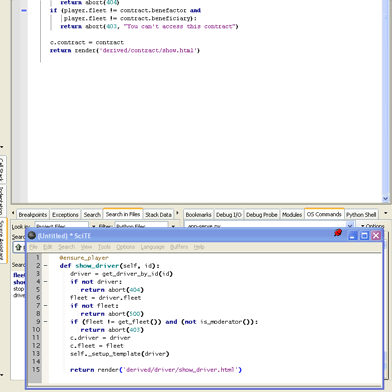
What helps immensely in this situation, is a small text editor sitting at the bottom of the screen (just below the code edit area). On Windows, I use the brilliant DeskPins tool. I pin one of my notepad windows on top with it, and then simply paste anything I need into that. When not needed, the window can be simply minimised.

It looks like this, and works extremely well:


Naturally, this works ideally no matter what set of IDEs and tools I'm using, which is a great bonus. The editor is SciTE, which is the best Notepad replacement in the history if the universe.

Friday, May 16, 2008

0th reason for UML's demise

Little tutorials discusses why UML has lost. It's a correct, if slighty tedious, overview of why the favourite bullshit "technology" of the 90s failed.

Naturally, it fails to mention the main, zeroth, reason: the sort of people who ever cared about nonsense like UML are also prone to spending countless hours categorizing and discussing the patently obvious.

Sadly, this can be traced as the reason for the apparent popularity of many other "technologies" out there. REST anyone?

Monday, October 8, 2007

Can your clustered software platform do this?

Disclamer: I actually know nothing about cluster software environments. And what I call "threads" below aren't actually threads.

Suppose you're developing some sort of clustered multi-processor system. The sorta thing that runs on many computers, and uses fairly complex inter-node interaction with various bits of shared state and whatnot (i.e., something more involved than parallel processing jobs with a message bus in-between). Say, it's a clustered Instant Messaging server, or some sort of a HA database system.

For development, you're running many processes on your workstation, or have some sort of a test cluster thing. All of that is using sample datasets, debug clients, etc.

Now, the problem is that changing code while developing this system is a nightmare. Most of the time, any single change will require recompiling the thing, restarting parts (or all) of it, and then going through all the motions necessary to get it into the desired state. At which point the freshly-written code is debugged, new issues are found, and the whole cycle needs to be repeated. A nightmare.

Well, today I found myself in just such a situation: developing a clustered system that does something or other in many processes spread accross multiple machines. Only (of course) it was all being done in Erlang. And it was a pleasure.

I would be poking at the cluster through Erlang shell (an interactive yoke similar to what one finds in Python or Perl, only this one was running as part of the cluster, so I could easily examine states of various bits of code running on various machines, send them commands, kill & restart threads, etc.) When this poking found an error,
I simply fixed it in code, compiled that, and then issued this command at the shell:

rpc:multicall(nodes(), c, l, [my_module]).

What this says is "on all erlang processes known, purge old version of code for my_module, and replace is it with new version from disk". What it does is, it goes to every
connected Erlang node (and since Erlang clusters tend to organise into fully-connected graphs, that means all nodes in the cluster), finds all threads currently using code from my_module, and substitutes new code from disk instead. And it generally does it without affecting running in-memory state at all. Let me just repeat: I can change code a thread is running without restarting it, while keeping all of its associated in-memory data intact.

This way when I find a bug, or need some new feature, I can add it to my running cluster and have it available straight away, without any sort of restarting or messing necessary. It's very cool.

Monday, September 17, 2007

People who can't stop laughing on youtube.

After a very productive morning, here are some videos of people who cannot stop laughing:

  1. Silly americans
  2. German weather anchor
  3. Barbra Streisand

Tuesday, August 28, 2007

In the news: Stubborn corporation persists at banging its head against a wall.

Back in 2002 or so, when Nintendo was the only kid on the portable multiplayer block (for oh so many years) and getting massive bux out of it, some execs at a non-insignificant mobile phone maker got The Envy. Here they were, busting their ass, trying to make more and more annoying innovative mobile phones, trying to convince punters to buy the latest in glitz, and only really making any money on the hardware sales. Whereas Nintendo would simply barf a device, and then simply sit back and bask in all the revenue coming from every single game cartridge sold. They didn't even need to do anything (apart from an odd marketing event), with all the hard work of coming up with game concepts, carrying them through to completion, and recouping development expenses left to other people. Sweet gig.

No wonder Nokia execs got The Envy. Which compelled them to spend several years, countless millions of whatever money unit they use in Finland, and an immense amount of karma on a series (well, two, actually) of devices under the N-Gage brand. Only to have the whole thing flop, much to the amusement of game journalists and geeks worldwide.

Rather than quietly forget their failure and move on, Nokia kept the ship afloat by turning the brand into a platform running on their smartphones. And fuelling it with monthly press releases, mainly designed to feed Wall Street.

The latest piece of the saga came in the form of an article in The New York Times. It's a fairly entertaining piece about the new generation of N-Gage brand, launching this week. The article is full of enthusiastic observations about all the new and innovative stuff Nokia prepared for its comeback. Let's see:


In 2005 and 2006, members of Nokia’s N-Gage team spent time with Ideo designers in San Francisco. The groups took research trips to six cities around the world, including Barcelona, Tokyo and Shanghai, to study how people played games and what they wanted from games on their phones.


Well, that's fair enough I suppose. Considering how much attention was paid to needs of potential gamer customers in the previous attempt, it'd be foolish not to do at least some due diligence here. And what did they come up with?


The Ideo and Nokia executives concluded that users mainly want to play against their friends and, at the very least, they want to know the skill level of their opponents. ...


Wow. Research shows that players don't really like having their ass kicked by some random Japanese dork with too much free time. Who would've thought?

Here's how I would like to see them arrive at a solution for this perplexing quirk of the psyche: A cool-looking head of creative design director dude, wearing shades that aren't even in the shops yet, gathers his creative design innovation team and presents the problem to them. The whole team then works furiously for a month, going on meditation trips to the Andes, brainstorming in pristine white rooms, experimenting with mind-expanding drugs, and even going as far as to consult children. Then they come back with a beautifully presented document with the solution:


… the new N-Gage permits users to see what games their friends have on their phones and whether they are online. They can also see how many points a person has earned in the game, as well as how much time they devote to solitary play versus group play.


Ahem, apparently in reality they just wrote up a proposal replicating what every other online platform in the universe does, and then probably fudged some timesheets and billed Nokia for sushi deliveries to the office twice a week. But did they stop there? How could they, Nokia has so much money!


The researchers also asked players what their greatest frustrations were. High on the list was buying a game that turned out to be disappointing.


No one ever gets frustrated with how much The Simpsons Movie sucked, after going to see it instead of drinking a few pints. But games now, they are so much different. Who would've thought, without an expensive research effort, that people get a tad annoyed at all the games being sold to them that turn out to be utter shit. So the smart folks at Ideo had to come up with an innovative solution to this problem:


In the new N-Gage service, customers will be able to sample games free before buying them.


Mind boggles. This service is going to be so full of innovation, it'll take the industry by storm. I'm off to buy some Nokia shares right now.